
Human oversight is useful only when an approval refers to a specific action, record version and authorized reviewer. This practical guide follows a fictional purchase-request workflow through evidence, policy checks, human review, secure execution, audit and timeout recovery.
When an AI recommendation becomes an action, who is responsible?
Imagine an assistant reviewing purchase requests. It notices two requests that look alike and recommends canceling one. The suggestion might be useful. It might also be wrong: the items could have different cost centers, delivery dates, or owners.
The design challenge is not simply whether a human clicks “Approve.” It is whether the system can prove what was approved, who had authority, which version of the request was examined, and whether the approved action actually happened—especially when a network call times out.
This guide develops a practical architecture for human-in-the-loop (HITL) AI workflows, with approval, audit and failure recovery treated as separate engineering concerns. It is a design pattern, not documentation of a deployed product. Every request ID, status and example below is fictional.
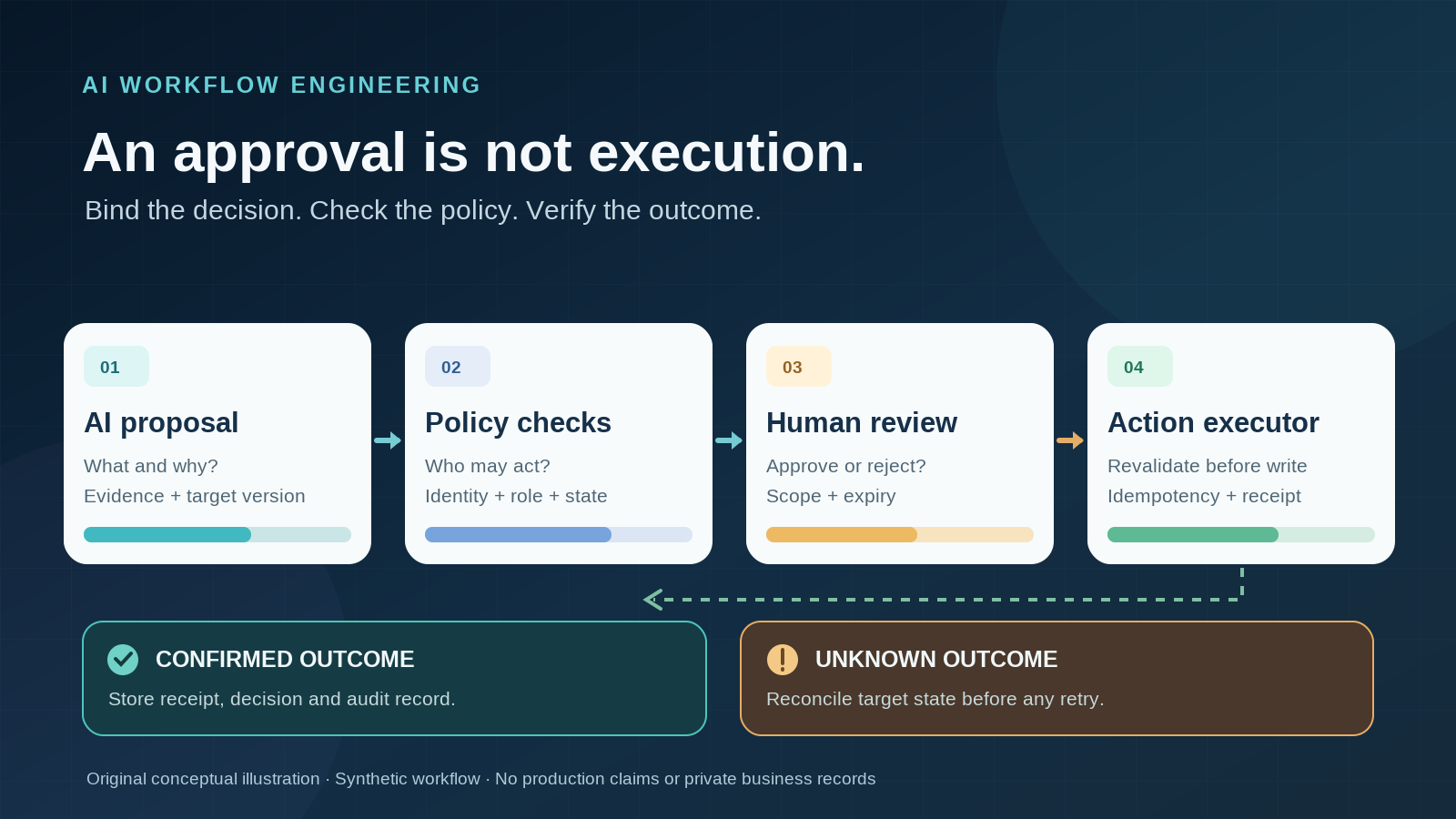
The short version
- AI proposes an action and supplies relevant evidence, uncertainty and a reason.
- Trusted software checks the target record, policy, permissions and current state.
- An authorized human decides on the exact, still-valid proposal.
- A separate executor acts only within that approval’s scope, then records the outcome.
- Recovery logic reconciles ambiguous results before a retry can cause a duplicate side effect.
This separation follows the general risk-management emphasis on roles and oversight in the NIST AI RMF and the least-privilege, human-approval guidance in OWASP’s Excessive Agency risk. Neither source certifies a particular implementation.
1. Begin with the business action, not the model prompt
A useful first question is: What can go wrong if this action executes against the wrong record? “Summarize a task” is different from “cancel a purchase request,” “send an external message,” or “change a payment destination.”
In a fictional purchasing workflow, suppose a model sees these two records:
| Field | Request A | Request B |
|---|---|---|
| Supplier | Example Supplies | Example Supplies |
| Item | 10 office monitors | 10 office monitors |
| Cost center | Team East | Team West |
| Needed by | 20 November | 25 November |
| Record version | 4 | 2 |
A text comparison might produce possible duplicate. But the different cost centers and dates are material. The right output is an investigation suggestion, not an instruction to delete B.
A proposal card should show the target ID, the original and suggested state, the reason, supporting fields, last-updated time, and whether the model lacked information. Presenting a bare “97% confidence” number without a calibrated meaning may be less informative than showing which attributes agree and disagree.
Microsoft’s Human-AI Interaction Guidelines emphasize making the system’s behavior intelligible and allowing people to correct it. In this workflow, that means reviewers need enough context to disagree well, not merely approve quickly.
2. Bind approval to an exact, expiring proposal
A generic approval flag such as “user approved task 42” is too weak. Between preview and execution, someone may edit the purchase request; the same approval must not silently authorize a different change.
Instead, treat each proposal as an immutable versioned object. A conceptual record could contain:
{
  "proposal_id": "proposal-demo-017",
  "action": "cancel_purchase_request",
  "target_id": "purchase-demo-B",
  "expected_version": 2,
  "reason": "Possible duplicate; human comparison required",
  "proposed_by": "ai_assistant",
  "expires_at": "2026-11-18T15:00:00Z",
  "approval_status": "pending"
}
This is illustrative data, not a production schema or a signed authorization token. A real design should bind the review to the relevant action parameters and record state—for example, a canonical request digest—and make the approval expire.
A robust decision sequence is:
- Present exactly what will change, including before-and-after values.
- Authenticate the reviewer and independently check their permission for this action and this target record.
- Require an explicit approve/reject decision, optionally with a reason.
- At execution time, recheck the record version, permission and approval validity.
- If anything changed, mark the proposal stale and request a fresh review rather than silently adapting it.
The distinction between a user’s general role and permission over a particular object matters. OWASP covers these failure modes separately in broken object-level authorization and broken function-level authorization. An AI interface cannot replace the checks in the service that actually changes data.
3. Put the irreversible action behind a separate executor
One safe architectural option is to separate a read-oriented proposal service from a narrow, policy-enforcing execution service.
| Layer | Responsibility | What it must not assume |
|---|---|---|
| AI proposal service | Identify candidates and explain evidence | Its own suggestion is permission |
| Policy and identity service | Validate action, target, reviewer and permissions | A front-end button is sufficient authorization |
| Review interface | Display scope and collect human decision | Old displayed data is still current |
| Action executor | Revalidate and perform one specific operation | A previous approval covers a modified request |
| Audit and reconciliation | Record decisions, attempts, receipts and unresolved outcomes | Timeout always means failure |
For a tool-using assistant or an MCP-connected application, the tool boundary is an authorization boundary. Tool descriptions or prompt instructions are helpful but do not confer permission. The server must enforce the user’s rights, allowed arguments and business rules independently of the model.
Avoid giving the model a general-purpose “run any update” tool when the workflow needs only “submit a cancellation proposal.” A smaller set of well-scoped capabilities is easier to review and limit. This is the practical implication of OWASP LLM06: Excessive Agency.
4. Build the audit trail around decisions, not just prompts
A chat transcript is not an audit trail. It can help reconstruct context, but it does not necessarily establish the identity, permission, target version or final outcome of a state-changing operation.
A useful conceptual audit record should answer:
| Audit field | Why it matters |
|---|---|
| Proposal ID and target ID | Which candidate action was reviewed? |
| Target version or digest | Was the approved state the one executed? |
| Requester and reviewer | Who asked, and who had authority to decide? |
| Decision and timestamp | Approved, rejected, expired or superseded? |
| Policy result and version | Which rules allowed or blocked the action? |
| Execution attempt and idempotency key | Was the action attempted or safely retried? |
| Result receipt / error class | Did the target system confirm the outcome? |
| Correlation ID | Can operators follow the same case across services? |
Record enough to investigate a decision without copying unnecessary personal data, secrets or full sensitive prompts into logs. Access controls, retention policies and any applicable legal requirements still need separate design decisions.
Be precise with statuses. “Approved” means someone authorized a proposal; it does not mean the business system finished the operation. “Submitted” is not necessarily “completed.” And “unknown outcome” is not the same as “failed.”
5. The timeout problem: do not double-execute an approved action
The subtle failure occurs after approval.
Suppose the executor sends a cancellation request to the purchasing system. The network connection times out before the response arrives. Did the cancellation occur?
There are at least three possibilities:
- The target never received the command.
- It received the command and applied the change, but the response was lost.
- It received the command and is still processing.
Blindly retrying may create duplicate work or trigger another side effect. A more reliable approach combines idempotency, state reconciliation and a clear unknown-outcome state. AWS’s Well-Architected guidance on idempotent mutations explains why repeated requests should not produce repeated effects.
For this fictional workflow, I would design the sequence as follows:
- Generate an idempotency key for the specific approved operation, not a new key on each retry.
- Persist an execution attempt with that key before calling the external system.
- Submit the action to an endpoint that enforces idempotency if the endpoint supports it.
- On timeout, mark the outcome unknown; query the target’s authoritative state or receipt.
- Retry only if the target’s guarantees, reconciliation result and retry policy make it safe.
- If the state cannot be established, escalate for investigation rather than claiming success or failure.
Important limitation: an idempotency key in the caller does not magically make an arbitrary external API idempotent. If the downstream system provides no reliable idempotency or status lookup, some ambiguous cases require human reconciliation. The design must account for that fact.
6. Make failure recovery visible to the user
A well-designed interface should tell people what the system knows, not what it hopes.
| State | Safe interface message | Next step |
|---|---|---|
| Proposed | “AI suggested an action; nothing has changed.” | Inspect evidence |
| Awaiting approval | “An authorized review is required.” | Approve or reject |
| Stale proposal | “The record changed after this preview.” | Reload and review again |
| Approved / queued | “Approved; execution has not been confirmed.” | Track operation |
| Executing | “The action is in progress.” | Avoid a second submission |
| Unknown outcome | “We could not confirm the final result.” | Reconcile before retrying |
| Completed | “The target system confirmed the change.” | Show receipt and timestamp |
| Rejected / blocked | “No change was executed.” | Show a safe explanation |
A red error banner and a “Try again” button are not enough if retrying can duplicate an operation. Recovery must be implemented in the backend, then explained clearly in the UI.
A second concern is reviewer fatigue: if everything requires approval, important decisions may become routine clicks. Risk-based policies can route low-impact operations differently from irreversible or externally visible actions. Human review should be meaningful, with understandable evidence and a realistic chance to reject.
7. What to test before calling this workflow reliable
I would test the controls in isolation and end to end, with synthetic fixtures:
- Unauthorized reviewer: cannot approve someone else’s record or a forbidden action.
- Changed target: the old approval cannot execute against a newer record version.
- Replayed approval: the same decision cannot be reused for a different payload.
- Expired approval: execution rejects a proposal outside its validity window.
- Unexpected model output: malformed, missing or adversarial tool arguments are blocked.
- Timeout after success: reconciliation finds the completed operation and avoids a duplicate.
- Timeout before receipt: the system retains “unknown” until evidence is available.
- Repeated submission: the same idempotency key produces no repeated side effect where the downstream guarantees support it.
- Audit access: an investigator can reconstruct the event without exposing secrets to unauthorized users.
- UI comprehension: users distinguish proposal, approval, execution and receipt without verbal guidance.
For measurement, report observable results such as unauthorized actions blocked in a test suite, stale-approval rejection, retry behavior and user comprehension. Do not promote simulated tests into claims about production reliability. A successful unit test is evidence about that test, not proof of the whole system’s safety.
Frequently asked questions
Is human-in-the-loop the same as having an Approve button?
No. The approval must be connected to a particular action and record version; the reviewer must be authorized; and the executor must verify those conditions again. Otherwise the button can become a misleading interface element.
Can an AI agent decide which actions need review?
It can help classify risk, but critical approval requirements should be enforced by trusted policies outside the model. The model should not be able to downgrade an action to “no approval needed” through its own output.
Do we need to log every model prompt?
Not necessarily. Audit requirements depend on the use case and applicable rules. Prioritize target/action identifiers, policy versions, who authorized what, execution attempts and verified outcomes, while minimizing unnecessary private content.
Does a timeout mean an action failed?
No. It may have succeeded, failed or still be running. Reconciliation and idempotent interfaces are important precisely because a timeout does not establish the final outcome.
Does following NIST or OWASP make a system compliant or secure?
No. These are useful frameworks and risk references, not proof that a particular deployment is safe, approved or compliant. Security testing, organizational controls and domain-specific requirements remain necessary.
What this guide does—and does not—claim
This article is an original design walkthrough informed by the primary references listed above. The purchase requests, IDs, states and diagram are synthetic. I have not executed a live cancellation, measured approval latency, performed a production security audit or verified a deployed HITL executor for this article.
My public AI task-management portal mock is an isolated, preview-only example; it does not perform production write operations. For related context, read From AI prototype to usable product, AI task-management portal: MCP and approval gates, and Practical data validation for AI-ready pipelines.
Bottom line: human oversight is a system property, not a prompt. A trustworthy action needs a specific proposal, a real policy boundary, an informed reviewer, controlled execution, evidence of its outcome and a safe answer when the outcome is unknown.
Sources & further reading
- NIST — AI Risk Management Framework Core
- OWASP — LLM06:2025 Excessive Agency
- OWASP API Security — API1:2023 Broken Object Level Authorization
- OWASP API Security — API5:2023 Broken Function Level Authorization
- Microsoft — Guidelines for Human-AI Interaction
- AWS Well-Architected — Make mutating operations idempotent